
AI agents in Oracle Fusion are only as good as the context they work with. Out of the box, an agent knows the system: who reports to whom, which invoices are open, what a salary looks like. What it does not know is how your company actually works. At Oracle AI World 2026 in Las Vegas, Broadpin CTO Johannes Michler showed how an AI-generated digital twin of the organization closes that gap, both during a Fusion implementation and in day-to-day work with AI agents. Two of these agents are now available on the Oracle AI Agent Marketplace.
Beyond Fusion: Process-Driven AI Agents for the Real Enterprise
This blog was written by Johannes Michler (CTO) and Daniel Silter (Senior Principal Consultant).
Why business processes still come first
At Broadpin, business processes have always come before pure technology. The reason is simple: if you get the requirements wrong, everything that follows gets expensive. That is especially true for ERP, HCM, SCM, and CX implementations on Oracle Fusion.
But a business process is more than a sequence of steps. To implement a system well, you also need to understand organizational structures, data structures, system architecture, integrations, goals, strategy, risks, and test cases. Together, these elements form what Gartner calls a digital twin of the organization: a formal model of the company that serves as a stable baseline for implementation and documentation.
Building a digital twin used to be hard work
Broadpin has worked with best-practice process models for Oracle ERP, HCM, SCM, and CX for many years, so no project ever started from a blank page. Adapting those models to an individual customer, however, required three things at once:
System knowledge: how Oracle Fusion works
Domain knowledge: how the customer's business works
Modeling skills: how to turn all of this into a consistent model
Bringing these together took time and effort, which made a full digital twin a significant investment.
How AI changes the equation
Large language models from providers such as Anthropic or OpenAI can now take over a large part of this work. They combine unstructured input from the customer with Broadpin's best-practice business processes and their own general domain knowledge. As a result, the team only needs to add what is truly specific to the customer.
The digital twin generation shown in the session comes from a real customer project. For the demo, Broadpin simplified and anonymized the case into a fictional company that refurbishes used e-bikes, recycles components, and sells to both consumers and businesses. The company wants to move CX, ERP, SCM, and HCM to Oracle Fusion. The input was a short company description and an unstructured Excel list of requirements. From this, the AI working with Broadpin's Horus tools generated a complete digital twin, 100% automatically:
High-level business processes with drill-down to individual steps and Fusion screens
Context, data, and strategy models, KPIs, and project risks
A system architecture model
The imported ERP requirements
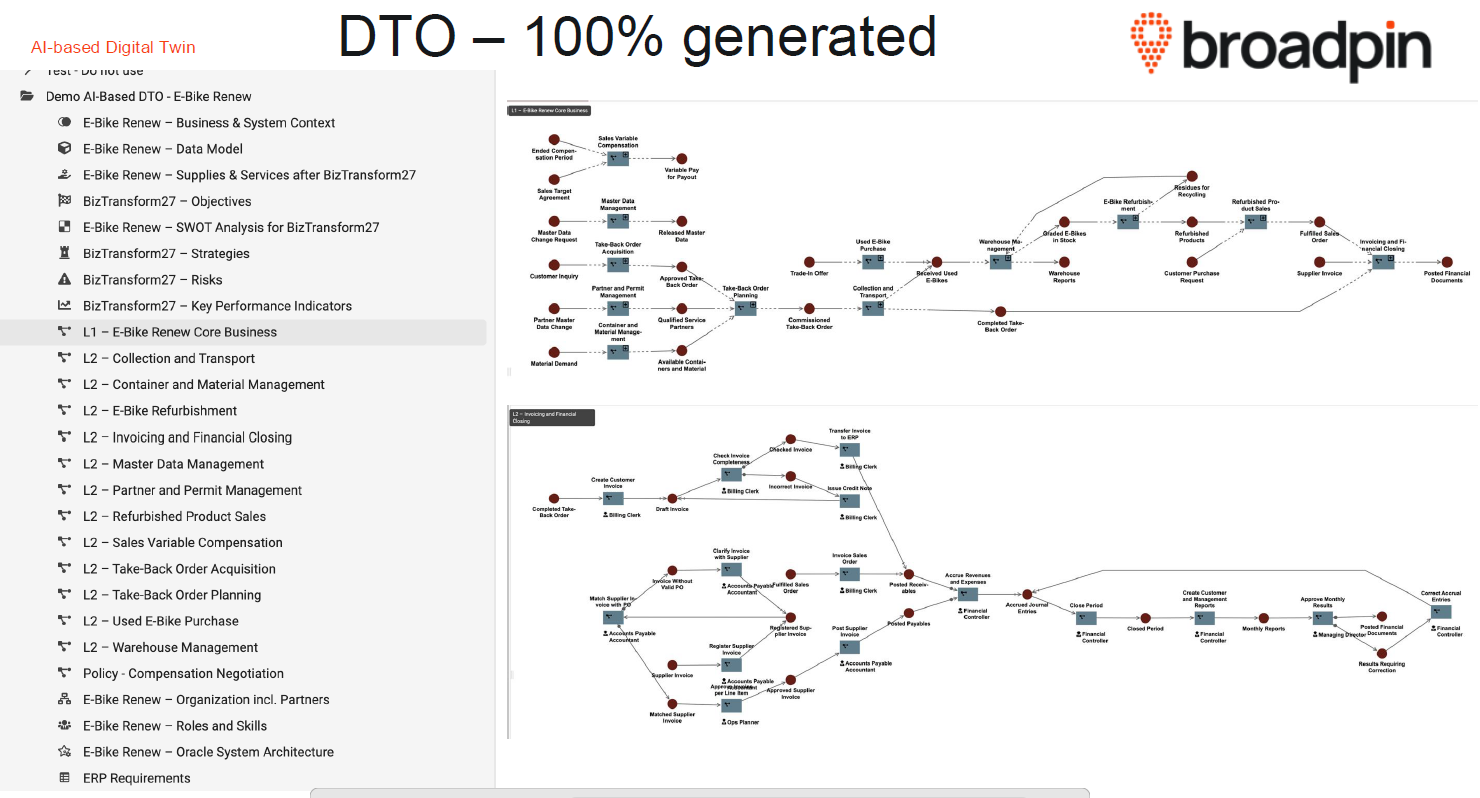
The digital twin for the demo company, generated 100% automatically: from business context and strategy to process models and system architecture.
The result supports a semi-automated Fusion implementation. It also gives business users documentation that stays current, instead of a process manual nobody updates.
Agent 1: Process Intelligence Assistant
The first agent brings the digital twin directly into Oracle Fusion. From their Fusion dashboard, users ask questions in plain language, for example: "I'm an e-bike assessor. What is my role when we buy used e-bikes from private sellers, and which systems do we use?"
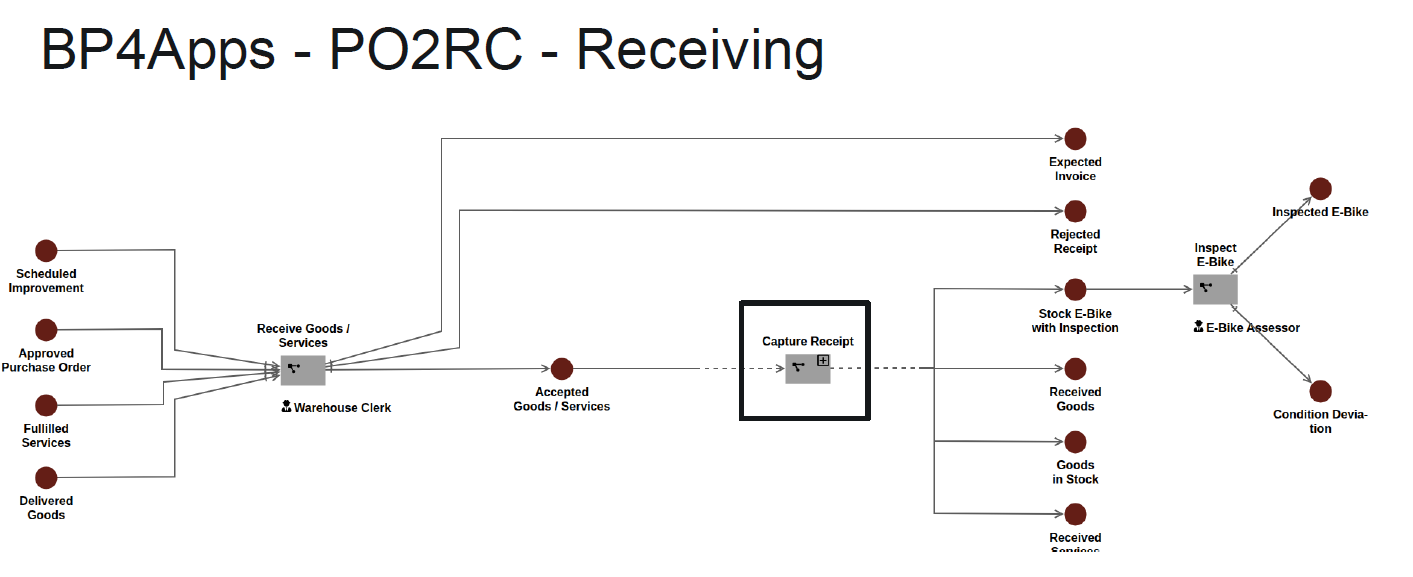
The receiving process from the digital twin, including the e-bike assessor’s inspection step. This is the model the agent draws on to answer role-specific questions.
The agent sends the question to the digital twin, works through the relevant models, and answers based on the company's own processes rather than generic Fusion documentation. Each answer links to the underlying process models, so users can check the details themselves. Technical questions work too, such as which data flows to Fusion run through Oracle Integration Cloud and what happens if an integration fails.
Agent 2: Compensation Negotiator
The second agent goes a step further and supports an actual business process: preparing salary negotiations. It combines three sources:
Oracle Fusion: employee data, current salary, and the date of the last adjustment, always within the privileges of the user asking
The digital twin: the company's bonus policy and the rules for what managers may and may not offer
Third-party systems: for example, sales performance data from an on-premises system such as Oracle E-Business Suite, retrieved through a web service
A manager can ask whether a specific employee is eligible for a raise. The agent pulls the last four quarters of sales data, checks the bonus policy, and outlines the options within policy. If the manager asks about someone outside their team, Fusion security applies and no data is returned.
Looking ahead: Fusion Claw and the digital twin as guardrails
At this year's AI World, Oracle also announced Oracle Fusion Claw. It works as an execution engine inside Fusion: AI plans what to do, then calls deterministic Fusion tools to evaluate options. That matters because you do not want to send millions of general ledger rows to a large language model. The aim is to turn a system of record into a system of outcomes, where you state a goal such as better utilization and the system works out how to get there.
That kind of autonomy needs clear boundaries: goals, limits, rules, and standard operating procedures. This is exactly what a digital twin of the organization already holds. Process models, roles, organizational structures, risks, and KPIs can define the operating boundaries for Fusion Claw, so AI acts the way your company works.
Bring your processes into the AI conversation
AI agents become truly useful in Oracle Fusion when they know your processes, not just your data. Want to see how a digital twin of your organization could speed up your Fusion implementation or power your own agents? Contact our Oracle Fusion team to talk through your use case.
Watch the full session on the Broadpin YouTube channel or on the Oracle ACE channel.