Every year the goal setting cycle starts, managers and employees meet and set new goals. And then you probably find yourself in the same situation: sitting in front of a blank page and feeling stuck. Oracle HCM Cloud offers a practical way past that blank page. With a single click on the AI Assist button, the system reads the goal name and pre-fills the description and success criteria, giving managers and employees a concrete starting point to refine together. It is worth looking at the feature closely.
AI-Assisted Goal Setting: From a Blank Page to Meaningful Objectives
This blog was written by Katharina Mayer (Senior Consultant Digitized Processes).
Goal Management in Oracle HCM Cloud
Goal Management is the module inside Oracle Fusion Cloud Talent Management that holds the annual objectives of an organization. It is the structural counterpart to the performance review: goals are defined at the start of a cycle, tracked during the year, and then evaluated in the performance document.
Oracle distinguishes two goal types, and the distinction matters more than it first appears:
Performance goals are outcome-oriented. They describe what an employee is expected to deliver within a review period, usually derived from team or company objectives. They live inside a goal plan that is tied to a review period, they can be assigned in bulk by HR, cascaded from a manager to a team, or aligned to organizational objectives.
Development goals are person-oriented. They describe how an individual wants to grow: a skill to acquire, a behavior to strengthen, a certification to obtain. They are not bound to a goal plan in the same way and typically originate with the employee rather than with management.
In both cases the data model is essentially identical: a goal name, a description explaining the purpose and context, success criteria that define measurable completion, a start date, a target completion date, a category, a priority, plus status and completion percentage for tracking. The page can be adjusted to customer requirements.
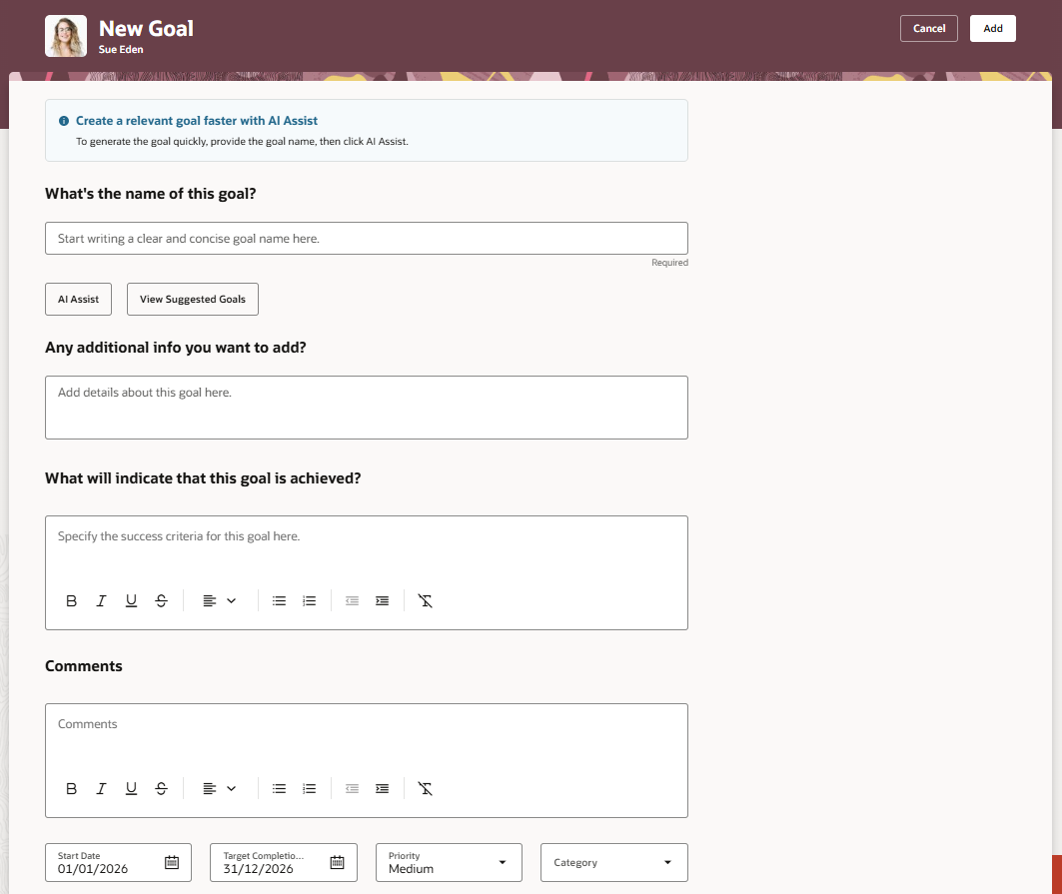
The form itself is simple but filling it in well is not. Writing a precise description and, above all, formulating success criteria that are actually measurable is the part where the process quietly stalls every year.
The Feature: AI-Generated Goal Descriptions
Oracle addresses exactly this bottleneck with an AI assistant embedded directly in the goal creation page. The workflow is deliberately minimal. On the New Goal page, the user enters only one thing: the goal name. Then a button labelled AI Assist appears right below the field. A single click, and the generative AI service reads the goal name and populates the remaining narrative fields of the form.
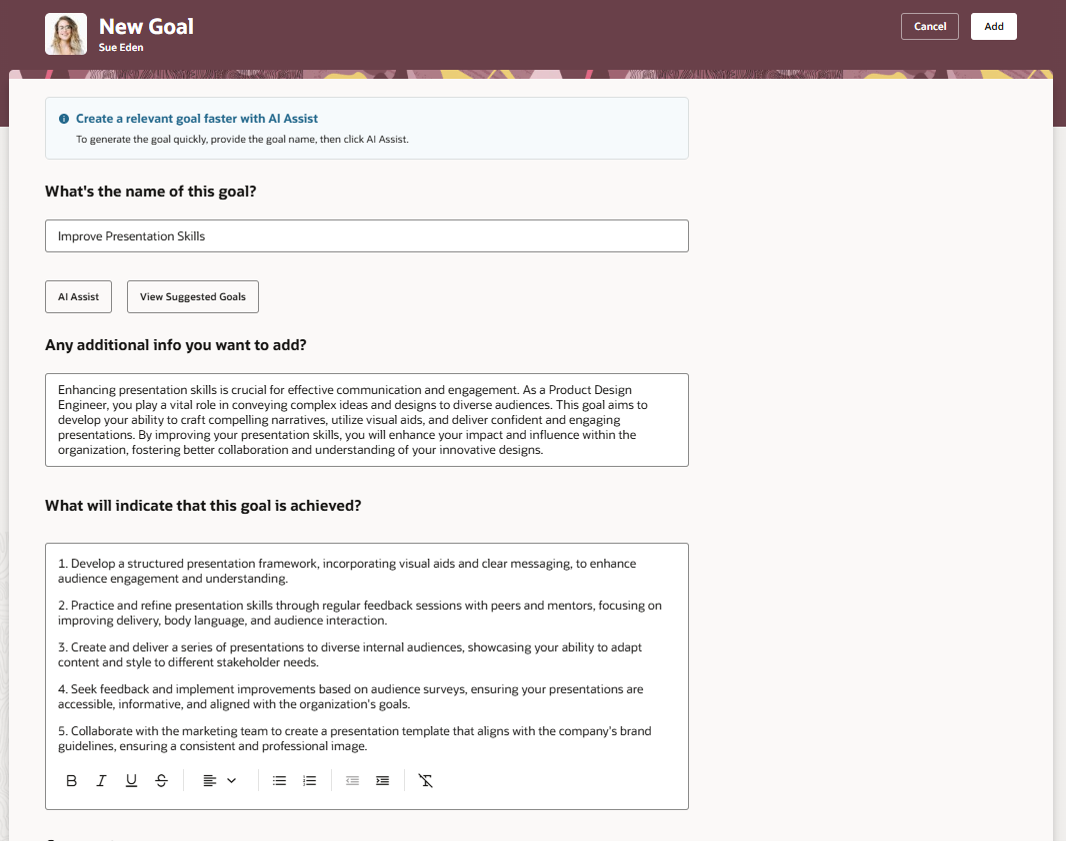
Take the example from the screenshot with the input "Improve Presentation Skills" and the output, which appears within seconds:
A description in the "Any additional info you want to add?" field. It frames the goal in professional terms: why presentation skills matter, that effective presentations help to convey complex information clearly, build rapport with an audience, and support influence on decisions, and what the goal is meant to achieve overall.
A set of success criteria in the "What will indicate that this goal is achieved?" field, generated as a numbered and measurable list. In the example the AI proposes five items, ranging from delivering a presentation with a clear structure and effective visual aids that receives positive feedback from at least eighty percent of the audience, through incorporating interactive elements to raise engagement, mastering storytelling with real examples, using advanced presentation software for visual impact, all the way to regular feedback sessions with peers and mentors.
Two things are important about this design. First, the generated text lands in ordinary, fully editable rich text fields. Nothing is locked. The user can delete a criterion, sharpen a number, add the internal project that the goal actually refers to, and then save. Second, no prompt writing skill is required. There is no chat window, no prompt to formulate, no AI literacy training needed. The interaction is a button, and the button sits exactly where the user is already stuck.
Why This Matters: The Advantages
Speed. The obvious benefit. A goal that previously took ten or fifteen minutes of careful phrasing is drafted in seconds. Multiplied by every employee in a mid-sized organization, and by every goal per employee, the aggregate time saving in a goal setting cycle is substantial.
Better success criteria. This is arguably the bigger win. Descriptions are easy to improvise; measurable criteria are not. Most weak goals in HR systems are weak precisely because the success criteria are missing or vague. The AI produces a structured, quantified starting list, and editing a proposal is cognitively far easier than inventing one from nothing.
Lower barrier to entry. Development goals in particular depend on employees taking the initiative. A blank text box is a deterrent. A prefilled draft is an invitation. Adoption rates in voluntary parts of the talent process tend to respond directly to how much friction the first step contains.
Managers regain conversation time. The point of goal setting is the dialogue about direction and expectations, not the typing. Automating the drafting moves the human effort to where it actually creates value.
A Real Opportunity: Let Us Show You
Taken together, these capabilities change the character of the goal setting cycle. It stops being an administrative obligation and becomes something closer to what it was always meant to be: a structured conversation about performance and growth, supported rather than obstructed by the system.
The value, however, does not come from the feature alone. It comes from a considered rollout. That is where we come in. We help organizations assess, enable, and operationalize AI capabilities in Oracle HCM Cloud. Curious what this looks like in your own environment? Book a live demo with our Oracle HCM experts at Broadpin. We will walk you through the system and show you the Goals Center. Get in touch with the Broadpin HCM team.