Identifying, developing and retaining strong people has shifted from an HR routine to a strategic discipline. It is particularly relevant in times of skills shortage and demographic change, when the employees leaving carry decades of knowledge with them and the external market has little to offer as a replacement. Oracle HCM Cloud offers two closely connected instruments for precisely this: Talent Pools and Succession Plans. This article looks at what they actually do, how they work together, and where the practical value sits.
Talent Pools and Succession Plans in Oracle HCM Cloud: Building a Talent Pipeline before you need it
This blog was written by Katharina Mayer (Senior Consultant Digitized Processes).
Talent management has become a risk conversation
For years, succession planning lived in a locked spreadsheet on an HR director's laptop, reviewed once a year, forgotten by February. This model is no longer applicable, as it is difficult to fill job openings these days. Put differently: the external labor market can no longer be your primary answer to a vacancy. When a critical role opens up, the fastest and cheapest path to a qualified replacement usually runs through people who already work for you.
The problem is that most organizations cannot see those people clearly. It is precisely in this tension that an HR system demonstrates its value. This is the space Oracle Talent Management, part of Oracle Fusion Cloud HCM, is built for. It connects skills, recruiting, learning, career development, performance, and succession around one unified talent profile, so that people data, work data, and skills data sit in the same place rather than in four disconnected tools.
With Oracle Talent Pools and Succession Planning specifically, organizations can:
Identify employees with the potential to grow into new roles and build talent pipelines that increase organizational agility.
Uncover critical talent gaps and vulnerability risks by surfacing possible successors and evaluating their readiness.
Create and manage talent pools for genuinely different purposes: leadership tracks, scarce technical roles, regional benches, graduate cohorts.
Create succession plans in the form of an organizational chart to illustrate the relationships between employees, roles, and successors, as well as criteria such as readiness.
Get an overview of talent topics as well as connect succession tracking and analytics within the Succession Planning Dashboard.
Two components deserve a closer look: Talent Pools and Succession Management. The following sections cover both in detail.
Talent Pools: grouping people the way your business thinks
A talent pool is a group used to cluster people according to criteria such as potential, functional area, position, location, certification, or anything you can justify.
The classic example is potential. An organization segments its workforce into Early Talent, Promising Talent and High Potential, then treats each group according to its goals: different trainings, different events, different development. Nothing forces you to use this taxonomy. A manufacturing group might run Emerging Manufacturing Leaders. A shared service center might run Future Managers. A pharma company might run Qualified Person Bench. Customers define pools around their own requirements, not around a template. Pools are created from scratchh based on your requirements.
One detail matters more than it first appears: a person can belong to several pools at once. An employee can sit in Promising Talent and in Mid Management simultaneously, because the two answer different questions. One describes trajectory, the other describes organizational layer. Multiple membership is what allows pools to model reality instead of flattening it.
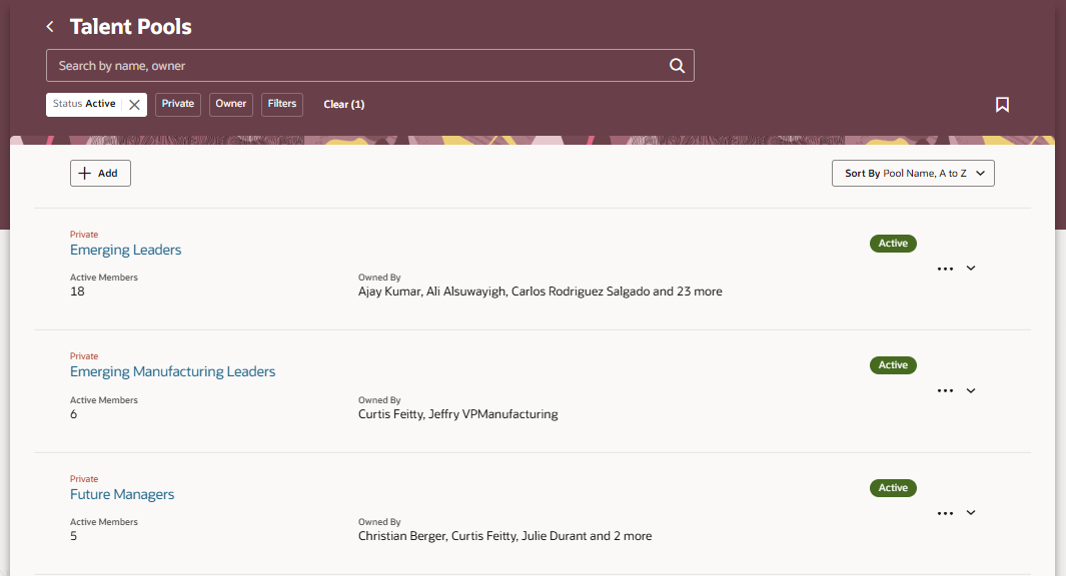
The screenshot below shows what this looks like in practice on the Talent Pools overview page. A few things worth noticing:
The overview page provides you with a precise overview of the existing pools and additionally new pools can be added.
Pools can be private or public. Private pools keep sensitive talent segmentation restricted to the people who need it.
Pools have owners, and often several of them. Emerging Leaders here is owned by more than twenty people. That is deliberate: pool ownership is how you distribute stewardship of talent across business units instead of leaving it with one HR generalist.
Pools carry a status. Rather than deleting a pool that has served its purpose, you set it to inactive and keep the history.
Development goals can be assigned to pool members, so a pool is not just a list. If the members of Future Managers should have a common goal, then Oracle lets you push those goals from the pool itself.
Succession Plans: naming the risk and closing it
Succession management answers a narrower and harder question: who replaces this person, in this job, in this position, and when could they realistically do it? Oracle supports plans for an incumbent, for a job or for a position. Candidates can be added manually. Each candidate carries a readiness assessment, so the plan distinguishes between someone who could step in tomorrow and someone who needs two years and a stretch assignment first.
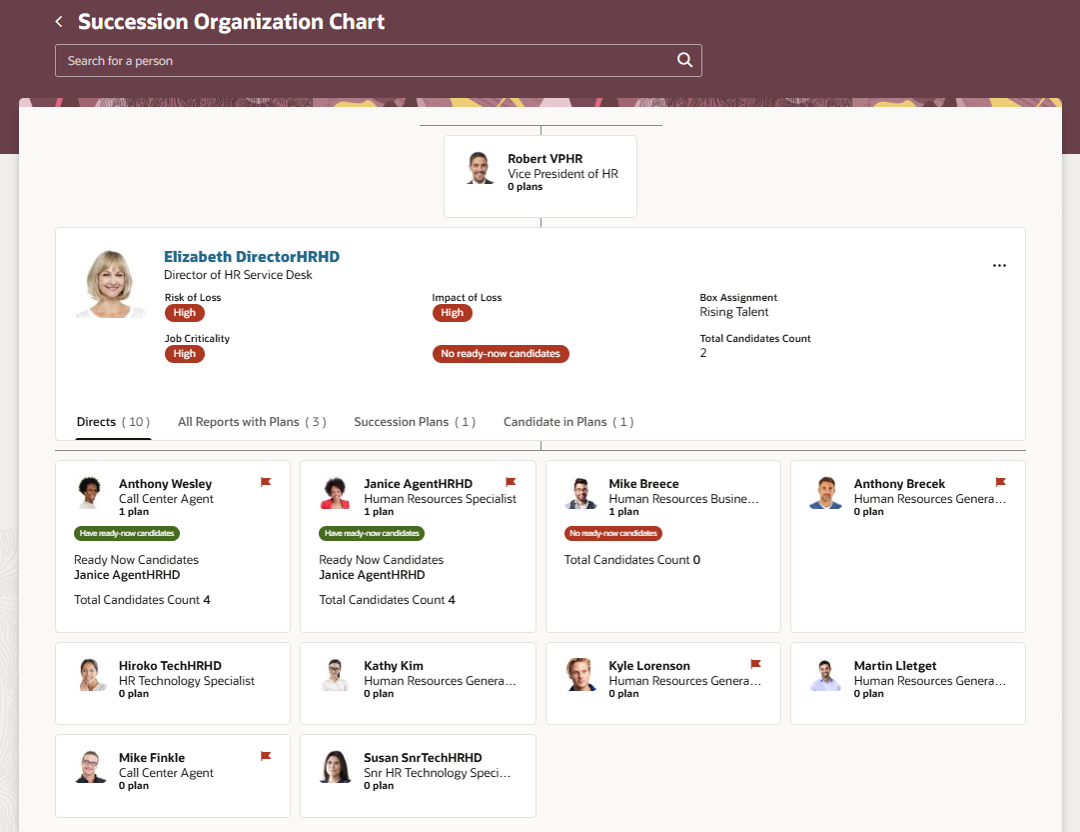
The screenshot below shows the succession organization chart, and it is arguably the most persuasive screen in the entire module for an executive audience. In a single view you get:
Risk of Loss, Impact of Loss and Job Criticality for the selected employee. That combination is the definition of a vulnerability: an important role, an important person, and a real chance of losing them.
A badge that highlights the candidate's readiness and indicates the timeframe during which the candidate is ready to take over the position.
Tabs that reframe the same data: direct reports, all reports with plans, the succession plans for this person, and the plans where this person is a candidate.
The advantages of working this way are concrete:
A smooth transition into key jobs and positions, because the conversation happened before the resignation letter.
Identification of workers who are ready now, or who can become ready by developing the necessary skills, for jobs and positions likely to become vacant.
Structured career development for candidates, since readiness gaps translate directly into development goals rather than good intentions.
What organizations actually get out of it
Taken together, Talent Pools and Succession Plans change the character of talent management. It stops being a spreadsheet reviewed once a year and becomes something closer to what it was always meant to be: an ongoing picture of who your critical people are, who could follow them, and how far away that readiness really is, supported by the system.
Once pools and plans are in place, the effects show up at once:
Targeted succession planning. Coverage becomes a number you can report on. Practitioners generally aim for two to three qualified candidates per critical position, spread across readiness horizons. Without a system, nobody knows whether they are at three or at zero.
Talent identification that is not based on volume of visibility. Pools and reviews surface people who perform well outside the line of sight of senior management. That is a fairness argument as much as an efficiency argument.
Faster and cheaper filling of critical roles. Internal moves shorten time to productivity and reduce agency spend. They also compound: every internal promotion creates a lower level vacancy that is easier to fill externally than the senior one would have been.
Decisions supported by evidence. Risk of loss, impact of loss, job criticality and readiness are captured consistently rather than argued from memory in a meeting.
Resilience. Illness, early retirement, a competitor's offer, a reorganization, an acquisition. None of these are predictable individually. All of them are survivable if the pipeline exists.
What's next?
Interested in seeing it in your own context? Get in touch with the Broadpin HCM team and book a demo. We will walk you through Talent Pools and Succession Plans in a live system, discuss what your current setup would need, and give you a realistic view of effort and value before you commit to anything.
The value comes from a considered rollout. That is where we come in. We help organizations assess, enable, and operationalize Talent Pools and Succession Planning in Oracle HCM Cloud.