
Recently Oracle announced the availability of a new CPU shape E3. Flex in its Oracle Cloud Infrastructure – see Oracle's documentation on compute shapes here. The announcement promises an increase in performance of around 50% compared to the current Intel CPU (e.g. in VMStandard2.x) at the same or lower cost. Reason enough for me to take a closer look at this in the area of operating the E-Business Suite on such instances.
Using latest flexible OCI E3 shape with E-Business Suite on OCI
This blog post was written by Johannes Michler (Chief Technology Officer (CTO) @ Broadpin & Oracle Ace Director). It was originally published on 23 June 2020 by PROMATIS, which is now Broadpin.
First Attempt: Changing an existing instance
For a first test I tried to change the shape of an existing (VMStandard2.4) instance to E3. Unfortunately, this failed because the image I used for this instance was too old (3 months old EBS@OCI instance):
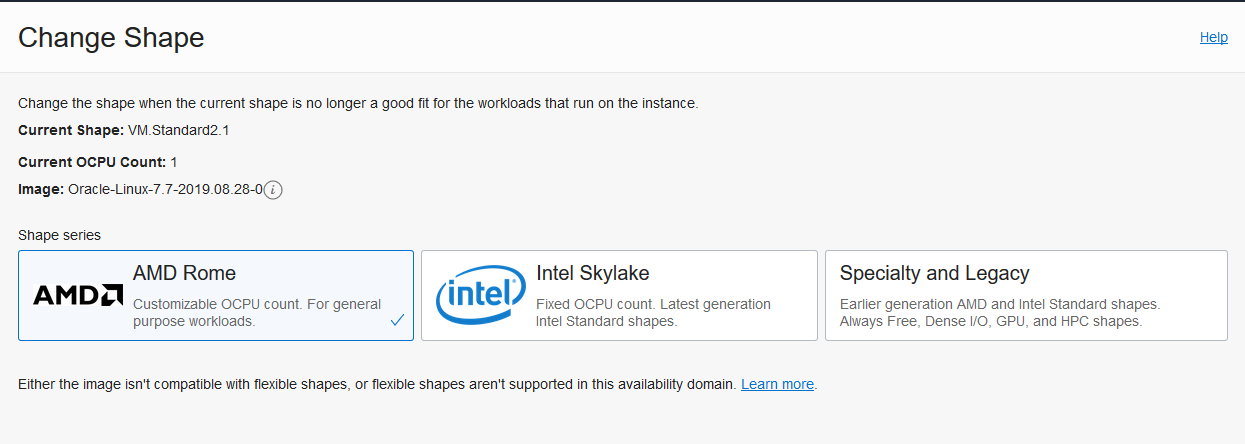
Since it is an image provided by Oracle, it is unfortunately not possible to overwrite/change it - even if I had patched my Oracle Linux to be compatible with flexible shape. The only workaround I see would be to create a custom image and adjust it to be compatible with the E3.Flex shape.
Second Approach: Cloud Manager 20.1
Oracle recently published Oracle E-Business Suite Cloud Manager 20.1, more precisely 20.1.1.0.1. Unfortunately, even there I am not able to choose E3.Flex shapes for newly created (or restored from Backup) E-Business Suite instances:
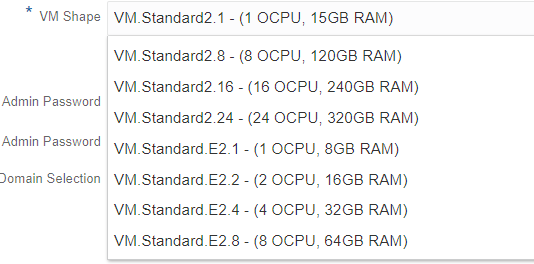
I am working with Product Management/Development for the Cloud Manager tools to make this available.
Nevertheless, there is some good news: When creating a new environment with a VM.Standard2.x shape, a current OS image is used that is actually compatible with the E3.Flex-Shapes:
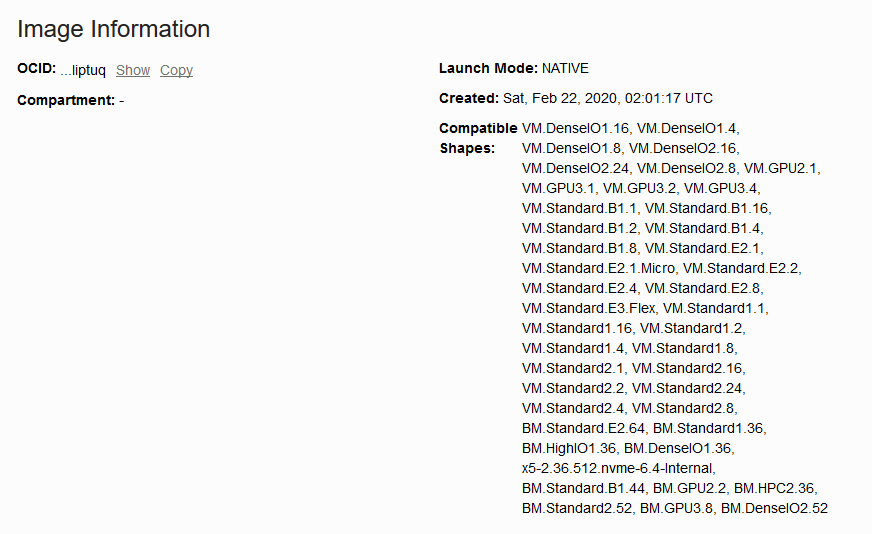
So after creating the instance (which is still done with the "old"/"slow" Intel CPU) you can change the shape via the OCI console (which triggers a reboot of the VM).
Note: Unfortunately you cannot convert an E2.X VM into the E3.Flex shapes, this gives the following error:
Requested shape: VM.Standard.E3.Flex belongs to a hardware series that is not compatible with the current shape: VM.Standard.E2.1
However, now that I have been able to get an E3.Flex instance, I have done some Performance Comparisons using sysbench (synthetic CPU performance) and OraPub Speed Test 3.
Performance with VMStandard.E2.4
As a reference the VMStandard.E2.4 gave me the following orabench performance on a 19c database instance:
Speed Factor (higher is faster) : 184.655 <----Performance with VMStandard.2.4
sysbench
With the following parameters:
[oracle@dbupg9db ~]$ sysbench --test=cpu --threads=8 runI managed to get the following CPU Speed:
Events per second: 5500.55orabench
The orabench value of the VMStandard2 CPU is appx. 40% higher than the E2 instance:
Speed Factor (higher is faster) : 255,4681 <----VMStandard.E3.Flex (4 Cores, 64GB memory)
But now let's have a look at the performance of the brand new E3 CPU.
orabench
The orabench Speed factor is appx. 20% faster than the Intel Xeon CPU
Speed Factor (higher is faster): 305,3364 <----sysbench
The sysbench compares similar; also there we get appx. 20% more performance:
[oracle@dbupg9db ~]$ sysbench --test=cpu --threads=8 run
events per second: 6777.76
Pricing
It becomes even more interesting when comparing the value per price. Let's take a look at the "per Cent" performance with orabench with the 4 benchmarks mentioned above (all tested on 4 core CPUs):

Summary
The new E3 shape has a similar "performance per price" as the old E2 shape had. The "value" and "absolute performance" is much better than the Intel Xeon VMStandard.2 cores.
This makes OCI an even better alternative to AWS in terms of "performance per price".
Finally, the higher "absolute" performance values are a big benefit when operating e.g. Oracle Databases licensed "per core". In that scenario, I have preferred VMStandard2.x over the E2 shapes in the past. But now I can also choose the AMD E3 Epyc CPU.